

Starting January 1, 2027, e-invoicing will be required in domestic cases specified by law. Consequently, concerns are already emerging among companies, accountants, and software vendors—concerns that stem more from their experiences with PDF attachments in emails than from the actual functioning of structured invoices.
The good news is that most changes can be handled without replacing the entire accounting system. It is important to understand how delivery, user access, and automated data processing work.
1. Myth: E-invoicing is a Slovak experiment
Electronic invoicing is not a development unique to Slovakia. It is based on European guidelines and uses the Peppol network for document exchange, which is already in use in several countries. For a company, this means that it does not connect to a closed local system, but rather to a standard designed for the interoperable exchange of documents.
When implementing electronic invoicing, it is helpful to understand who is affected by it and who will be required to receive or issue invoices.
2. Myth: An e-invoice is just a regular PDF sent by email
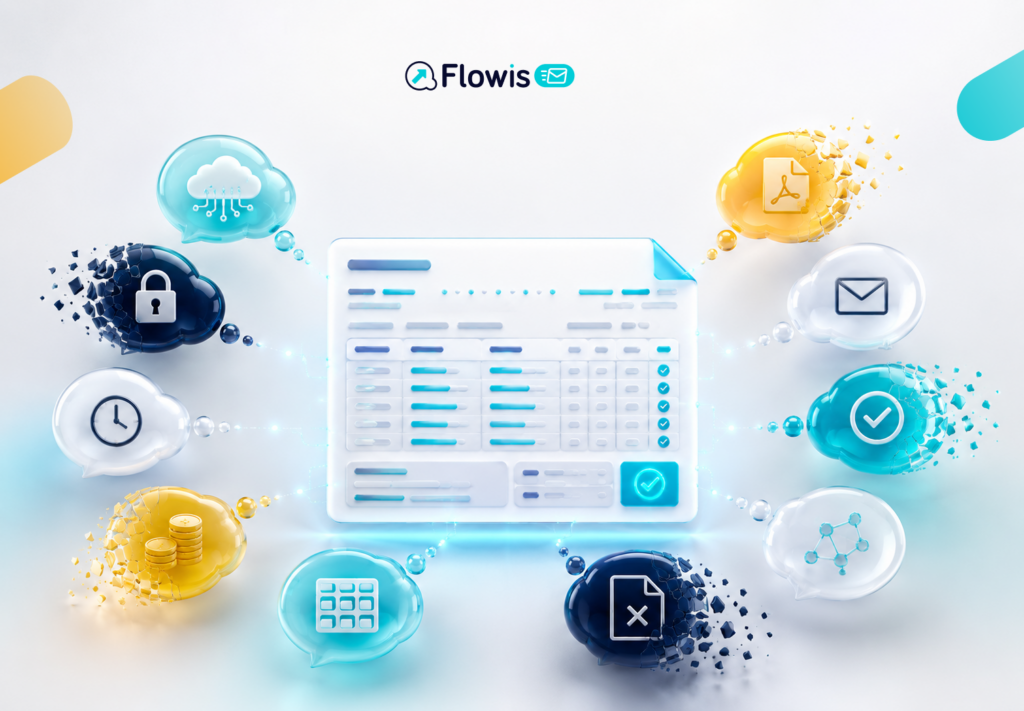
A PDF can be used to view a document, but the e-invoice itself is a structured document whose data the system can process automatically. This is precisely why a large portion of the manual re-entry of invoice numbers, amounts, VAT, and supplier information is eliminated.
In the digital mail client, the invoice is displayed to the user in a readable format, even though the data is received in a standardized format. This means the accountant will not be working directly with the XML file.
3. Myth: An accountant will have to learn the technical format of an invoice
The system handles the technical format in the background. The accountant needs to view the document, verify the data, then link it to an order in their system and post it. When receiving and sending e-invoices, users work with a user-friendly interface rather than manually parsing XML tags.
Upon delivery, an invoice can automatically appear in the web interface, where the business owner, accountant, or internal team can access it based on their assigned permissions. Accountants no longer have to wait for someone to download the document and forward it via email.
4. Myth: E-invoicing requires a new and expensive accounting system
Companies don’t need a new accounting system. For a smaller volume of documents, a web-based digital mail interface may be sufficient. If a company already uses an accounting system, it can supplement it with a feature for receiving and sending invoices.
With API integration, data from received e-invoices is automatically transferred to the accounting system. The accountant can then work within their regular accounting system without having to manually download, save, or retype documents.
5. Myth: E-invoices are less secure than email attachments
A regular email may contain a fake invoice or altered bank details. Electronic exchanges via Peppol rely on verified participant identities and secure transmission. This reduces the risk that a document will come from an unknown sender or be altered during delivery.
However, it is also important for a company to address user permissions. Data and process security is a critical issue. Not just anyone can be a digital mail carrier. It is important that they meet the technical and procedural requirements of eFaktúra, as well as the ISO and SOC 2 security standards .
6. Myth: If my partner and I agree to use email, I don’t need a digital mail carrier
An agreement via another channel does not guarantee that the company will be prepared to receive electronic invoices. Furthermore, in cases where the law permits an alternative method of delivery, an e-invoice still cannot be merely a PDF attachment. It must be a structured document.
Delivery via a certified digital mail service also provides a traceable record of when the invoice was sent and received. This is useful in the event of disputes regarding due dates, delivery, or delayed invoice processing.
7. Myth: E-invoicing is just another administrative burden
Its goal is to reduce administrative work. It will eliminate the need for manual data entry, reduce errors, speed up document processing, and simplify archiving. Information systems can process invoices automatically without the need for repeated data entry.
In subsequent phases, there are also plans to gradually replace certain existing forms, including the VAT control statement. This will eliminate the need for business owners to enter the same information on multiple forms.
8. Myth: An external accountant must have access to the company’s entire information system
An accountant does not automatically need access to all company data. The company can create a role for them directly in the digital mailbox’s web interface. They can view received invoices and process them, while the owner or manager retains control over approvals and user management.
Separating processing, approval, and payment in this way reduces the risk of errors and unauthorized actions. Workflow management helps clearly define who has which role in the process.
9. Myth: E-invoicing offers no real benefits to a company
The benefits go beyond faster delivery. The company gains a better overview of incoming and outgoing invoices, reduces manual work, lowers the error rate, and simplifies collaboration between accounting, finance, and operations.
In a unified digital environment for business processes, the receipt of a document can be linked to approval, accounting, and other steps.
10. Myth: There isn’t enough time to prepare for e-invoicing
Here’s how it really works: The year 2026 is a period of preparation and gradual adoption of e-invoicing ahead of the mandatory implementation on January 1, 2027. This gives companies time to select a suitable solution, verify the readiness of their accounting systems, and set up processes for receiving, processing, and approving invoices.
At Flowis Digital Mail, we strive to explain e-invoicing in a simple and practical way. We regularly host webinars on e-invoicing, where we address specific real-world questions, and we make important procedures available through manuals and documentation. We also share the latest information and brief explanations on social media: Facebook, Instagram, and LinkedIn.
What to Take Away from Myths
E-invoicing isn’t about a company having to manually handle more technical steps. It’s about the reliable delivery of data, making invoices available to the right people, and being able to process them without unnecessary re-entry.
The best results are achieved with a setup in which the digital mail carrier delivers the invoice, the accountant can process it immediately, the approver sees only their own actions, and the accounting system receives the data automatically.